Conclusion and Recommendations
Final Analysis and Business Impact
ImportantMilestone 4 Deliverable
This page is populated during Milestone 4 (Week 8) - Final Submission.
Executive Summary
This project studies five employment-related Reddit subreddits, systematically analyzing the structure and dynamics of online career communities from five dimensions: temporal trends, user behavior, text topics, emotional expression, and interaction mechanisms. By processing large-scale data using Spark and combining NLP and machine learning methods, this research reveals how these communities collectively reflect the pressures and emotional changes faced by modern job seekers in an uncertain labor market.
Key findings include:
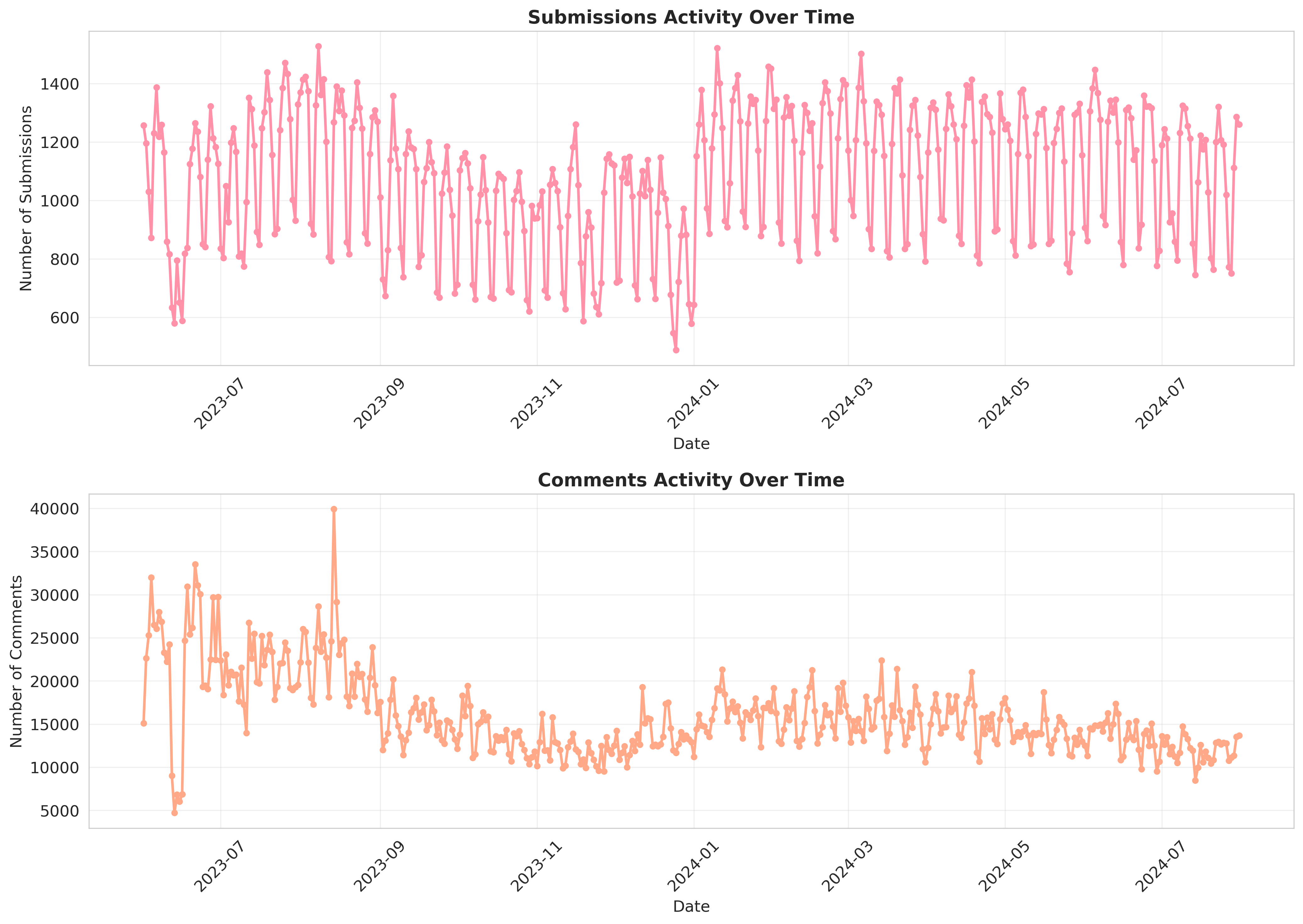
- Community activity reflects the cyclical pressures of the labor market. The number of posts and comments peaked in mid-2023 and subsequently declined, exhibiting rhythmic characteristics consistent with job-seeking seasons and fluctuations in economic sentiment.
- User behavior shows significant temporal patterns. Weekday midday (12-1 PM EST) is the most active period for interaction, indicating that users often seek information, vent stress, or find support during work breaks.
- Interactions exhibit an extreme long-tail distribution. The vast majority of posts receive little attention, while a small number of posts receive disproportionately high interaction, forming a typical “winner-take-all” dynamic.
- Content structure varies depending on the community’s purpose. Help-oriented communities (e.g., r/careerguidance, r/resumes) have a large volume of text but low interaction; complaint-oriented communities (e.g., r/antiwork, r/recruitinghell) have fewer posts but extremely high interaction, presenting a stark contrast.
- NLP analysis reveals significant consistent themes and emotional structures. Employment-related Reddit communities exhibit a unified thematic pattern—job search challenges and workplace stress are the absolute dominant themes, and all subreddits collectively reflect widespread concerns about interviews, rejections, recruitment processes, and burnout.
- Emotional patterns also highly consistently track labor market pressure: when the external economic environment is tense, the overall community sentiment is more negative; when the employment environment improves, positive emotions slowly recover. Certain communities (e.g., r/antiwork) can also serve as early “warning signals” for job seekers’ frustrations.
- Machine learning results show that interaction is predictable but strongly influenced by early feedback. Text features can moderately distinguish between high-interaction and low-interaction posts, while the quality of interaction in the first hour is a key factor in determining final popularity.
Overall, this project demonstrates that online employment communities are not only platforms for information exchange and emotional expression, but also important windows into observing changes in job seekers’ psychology, fluctuations in labor market sentiment, and the dynamics of career-related discussions.
Answers to All 10 Business Questions
EDA Questions
- [Question 1]: How does posting activity vary across time in these career-focused subreddits?
Posting activity peaked in August 2023 and declined steadily through mid-2024; comments dropped from ~40k/day to ~10–15k/day, suggesting reduced economic anxiety, user migration, or community fatigue.
- [Question 2]:When do users post and comment? What hours and days see the highest activity?
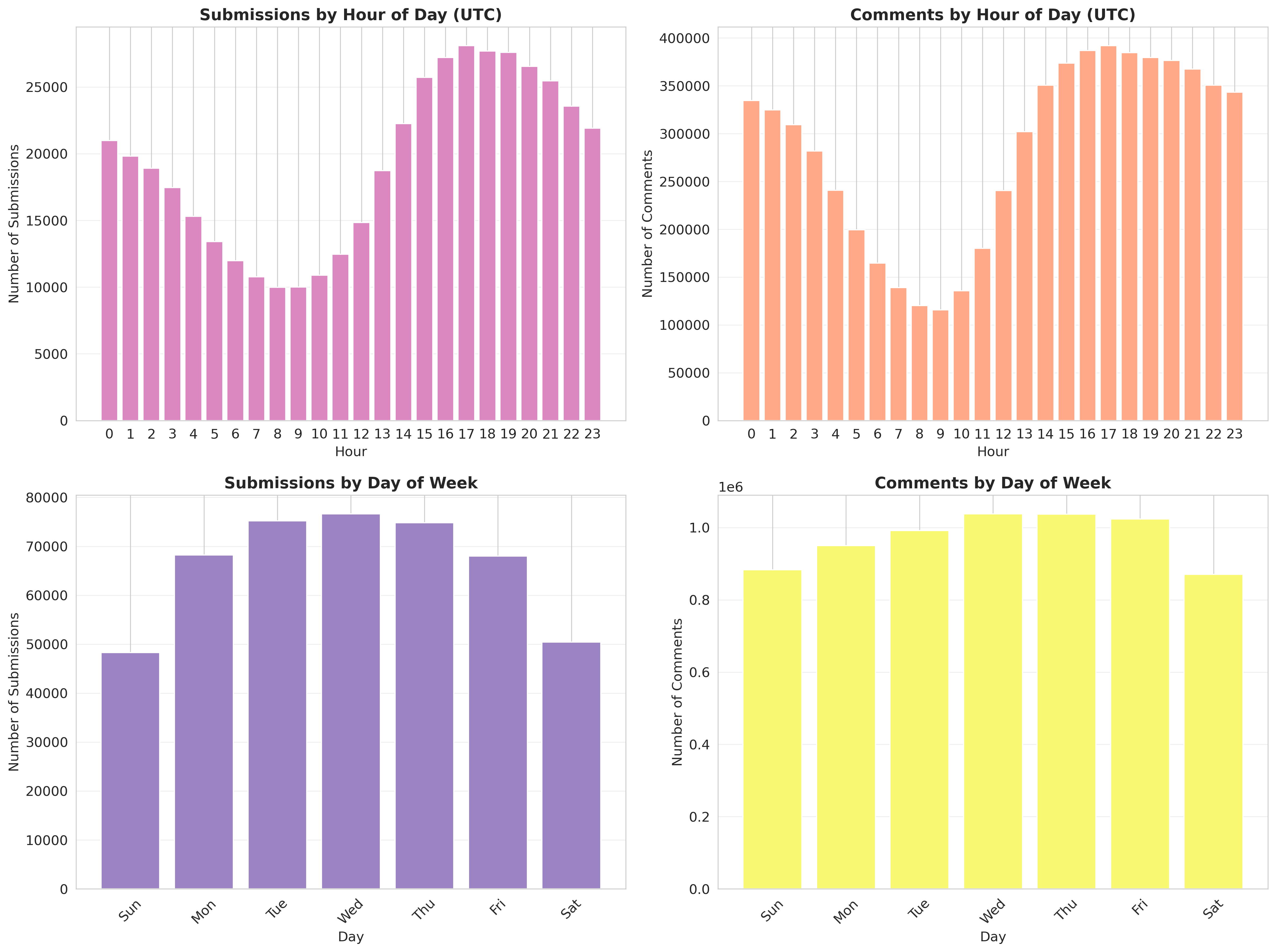
Peak engagement occurs at 17:00 UTC (12–1 PM EST) on weekdays, especially Wednesday and Thursday, indicating that users browse during work breaks; weekend activity is significantly lower.
- [Question 3]: When do users post and comment? What hours and days see the highest activity?
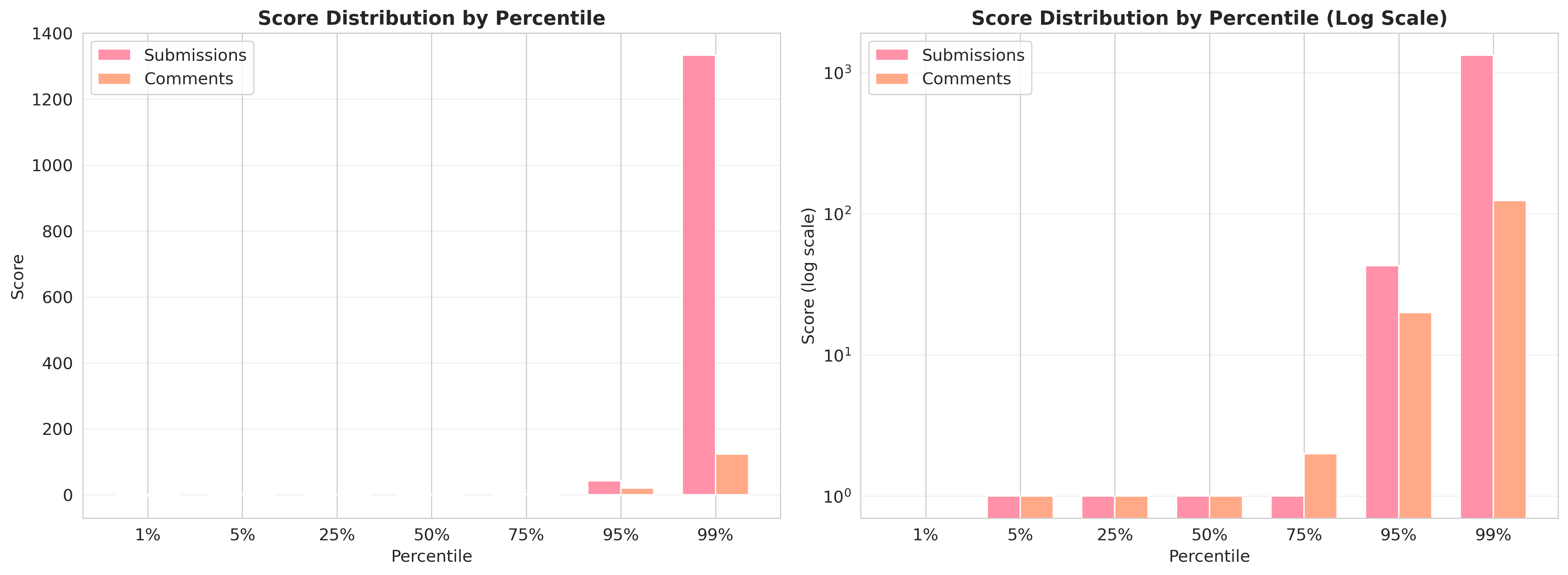
Both submissions and comments follow an extreme long-tail distribution: 50% receive ≤1 upvote while the top 1% receive 100×–1,000× more engagement, confirming winner-takes-all dynamics where visibility and early engagement dominate.
- [Question 4]: How do the five subreddits differ in terms of activity, engagement patterns, and community characteristics?
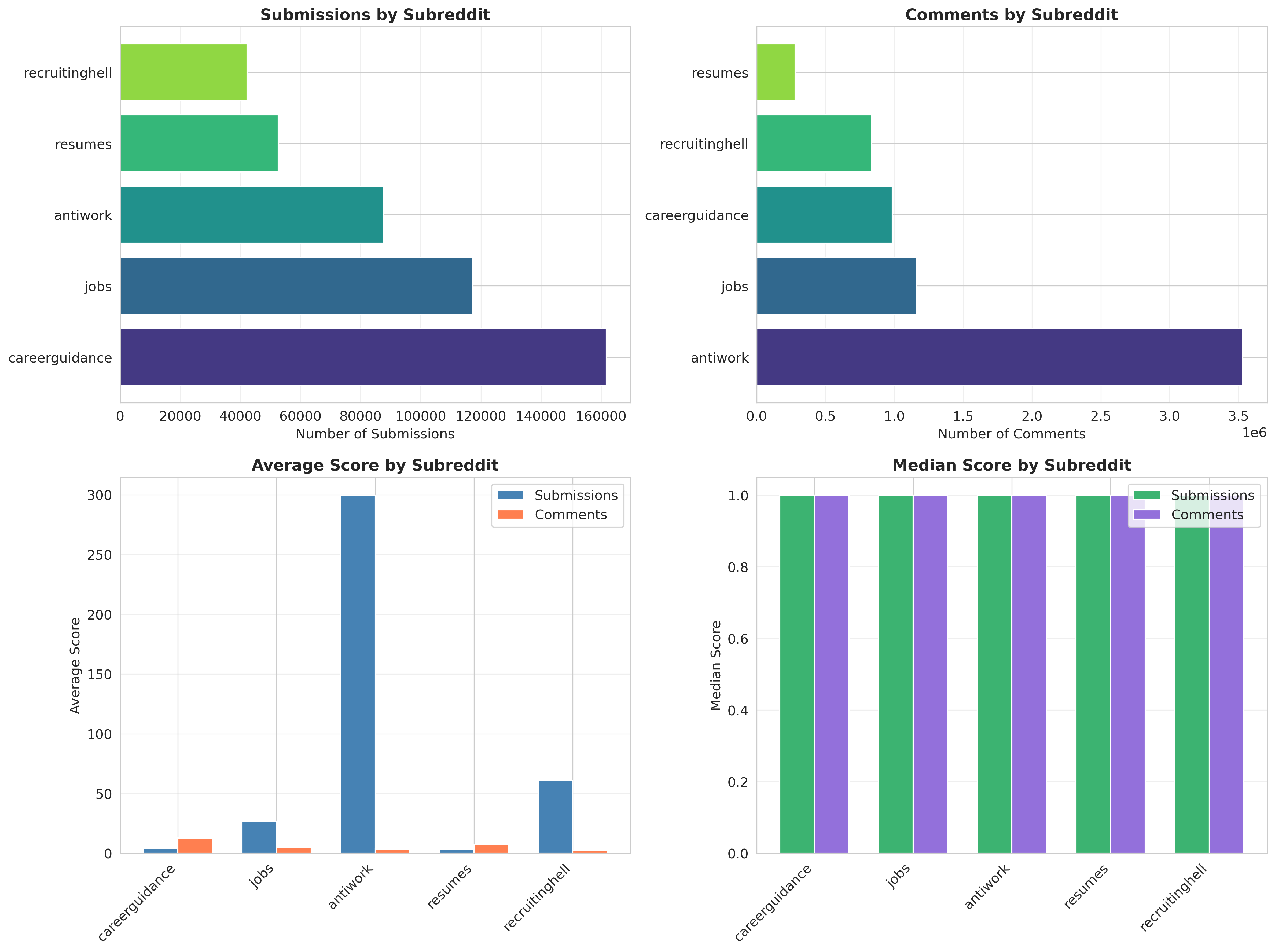
The five subreddits show distinct structural behaviors: help-seeking communities (careerguidance, jobs, resumes) have high volume but low engagement, while venting communities (antiwork, recruitinghell) produce fewer posts but far higher engagement and stronger discussion culture.
NLP Questions
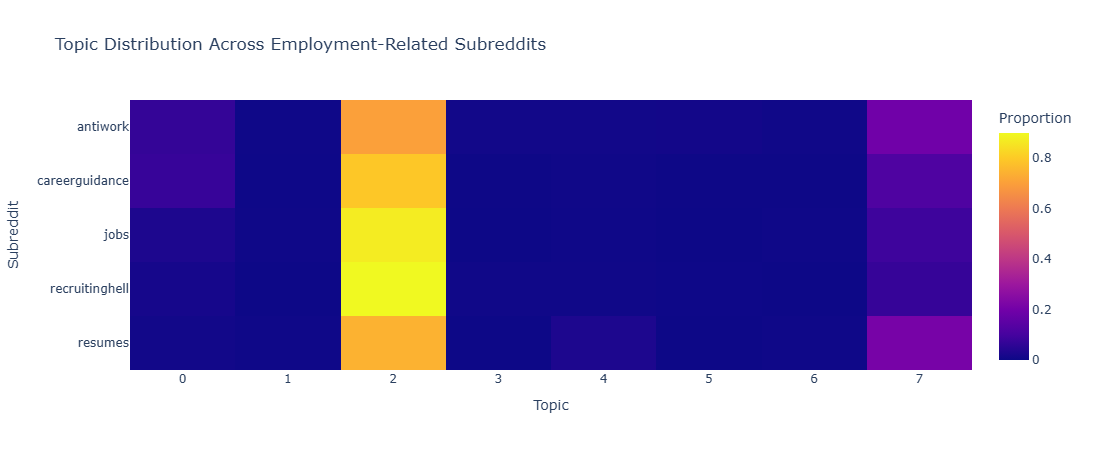
- [Question 5]: What are the dominant discussion topics across subreddits?
LDA topic modeling shows a highly unified thematic structure across all five employment-related subreddits.
A single topic overwhelmingly dominates:
- Topic 2 — Job Search Challenges (70–90% proportion)
This topic includes interviews, rejections, recruiters, hiring processes, and job-search stress.
A smaller secondary theme appears in all subreddits:
- Topic 1 — Workplace Frustration & Personal Experiences
Including burnout, toxic environments, low pay, and dissatisfaction.
Overall, conversations across these communities converge on the same core issue:
employment uncertainty and pressure during the job-search process.
Topic Distribution Across Subreddits
- [Question 6]: How does sentiment vary across subreddits and time?
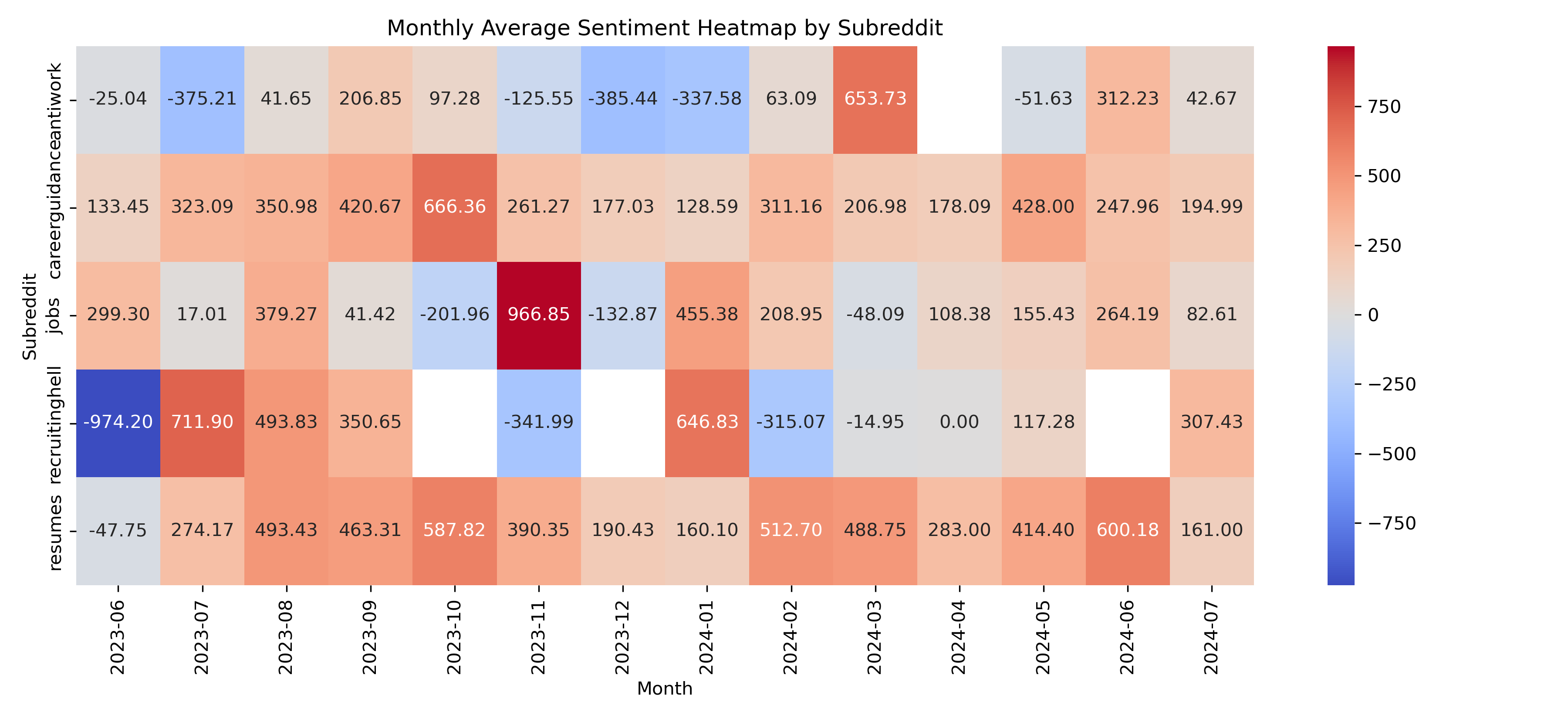
Sentiment analysis (VADER) reveals clear emotional differences:
- Positive communities: r/careerguidance, r/resumes
- Neutral / variable: r/jobs
- Negative & volatile: r/recruitinghell, r/antiwork
Monthly sentiment exhibits large swings, reflecting community purpose and real-world labor-market stress.
Despite fluctuations, constructive career-focused communities remain consistently more positive.
Monthly Sentiment Heatmap
- [Question 7]: Does sentiment influence engagement (score or comments)?
Correlation analysis shows that sentiment has weak but directionally consistent relationships with engagement:
- Negative sentiment → slightly lower engagement
- r/antiwork
- r/jobs
- r/antiwork
- Positive sentiment → slightly higher engagement
- r/careerguidance
- r/resumes
- r/recruitinghell
- r/careerguidance
This indicates that different communities reward different emotional tones depending on their norms and purpose.
However, overall interaction levels are not strongly driven by sentiment alone.
ML Questions
- [Question 8]: Can we predict high engagement posts?
Yes — moderately. Our Logistic Regression model achieves an AUC of 0.665, meaning it can distinguish high-engagement posts better than random guessing. 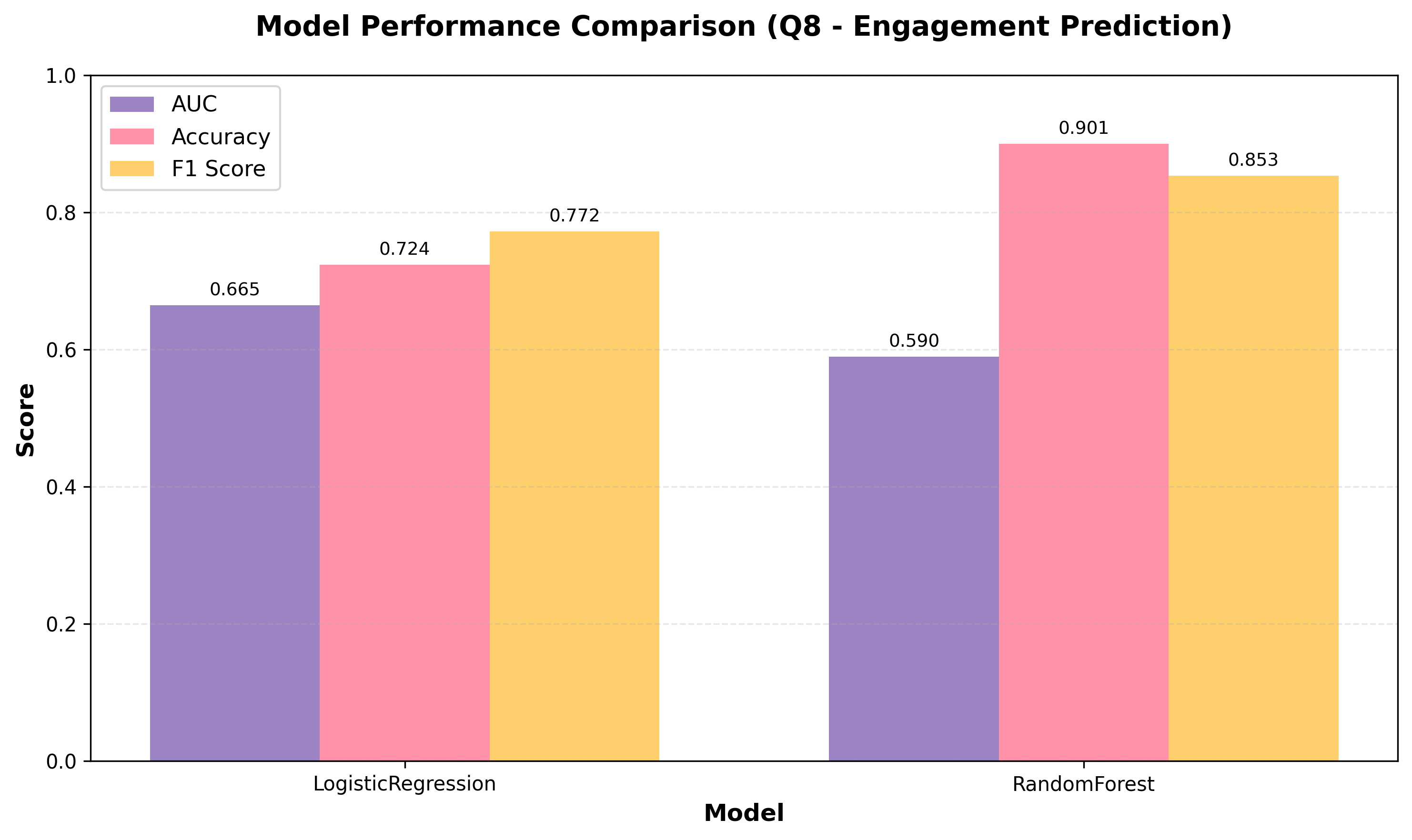
- Logistic Regression provides the most balanced performance, achieving the highest AUC (0.665), meaning it distinguishes high- vs. low-engagement posts more reliably.
- Random Forest achieves higher Accuracy and F1 Score, but its lower AUC indicates a bias toward predicting the majority class (low-engagement posts).
- Text-based features (TF-IDF) carry most of the predictive signal, while metadata such as posting hour and text length contribute smaller but still useful information.
- Overall, high-engagement prediction is moderately successful, with Logistic Regression selected as the final model for its better generalization and balanced performance.
- [Question 9]: Can early engagement predict final popularity?:
Yes — very strongly. Here we used a regression approach and trained both Linear Regression and Gradient Boosted Trees using first-hour engagement features, including:
- early comment count
- total comment score
- average comment score within the first hour.
Our Gradient Boosted Trees model explains almost 50% of variance (R² = 0.4952) in final popularity using early engagement metrics.
| Model | RMSE | MAE | R² |
|---|---|---|---|
| Linear Regression | 1.8026 | 1.2881 | 0.3154 |
| Gradient Boosted Trees | 1.5478 | 0.8228 | 0.4952 |
Feature Importance (Gradient Boosted Trees)
| Rank | Feature | Importance |
|---|---|---|
| 1 | early_comment_score_avg_1h |
0.4241 |
| 2 | title_len |
0.1765 |
| 3 | selftext_len |
0.1385 |
| 4 | early_comment_score_sum_1h |
0.1282 |
| 5 | early_comment_count_1h |
0.1052 |
| 6 | is_self_flag |
0.0275 |
- Quality of early comments (average score in the first hour) is the most important predictor
- Total and count of early comments still matter, but less than average score.
- Post title/body length plays a smaller supporting role.
- First-hour engagement acts as a critical window for predicting long-term popularity.
Feature importance reveals a clear insight:The average score of early comments is the most powerful predictor, more important than the number of comments. This suggests that quality of early discussion matters more than quantity.
- [Question 10]: Can we group posts into natural clusters?
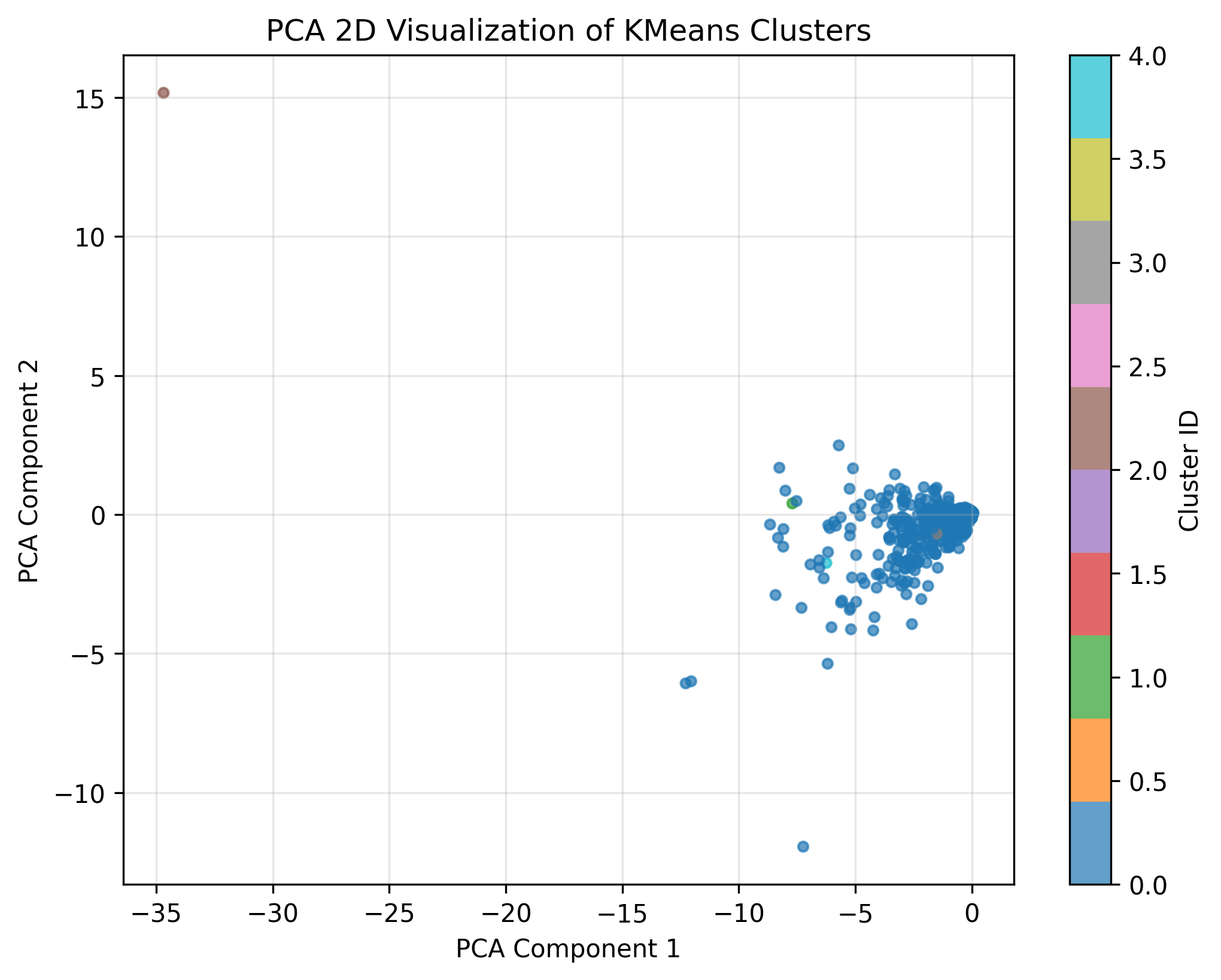
- A single large, dense cluster dominates the space (Cluster 0), indicating that most job-related posts share similar language patterns.
- Only a few small, scattered outlier clusters appear, but they are not semantically coherent enough to represent distinct themes.
- The PCA visualization confirms this structure: even after dimensionality reduction, the clusters do not separate into meaningful topic groups, suggesting high textual homogeneity across posts.
Major Findings
Key Insight 1: Engagement Is Highly Uneven and Driven by Timing & Subreddit Identity
Across all five subreddits, engagement exhibits strong temporal patterns and extreme inequality. Activity peaks during weekday lunch hours in U.S. time zones, and a small fraction of posts (top 1%) receives disproportionately high engagement. Subreddits differ structurally: help-seeking communities show broad participation but low average scores, while venting communities generate intense discussion and high comment-to-post ratios.
Business Impact:
Understanding when and where engagement concentrates allows platforms or moderators to surface valuable but low-visibility content, optimize posting recommendations, and design interventions tailored to community type—support communities need visibility boosting, while discussion-driven communities may require moderation load balancing.
Key Insight 3: Popularity follows a two-stage amplification process
Across all the mechine learning questions, we find that Reddit post popularity is driven by a two-stage mechanism:
- Stage 1 — Content Quality: TF-IDF features (Q8) determine the baseline engagement potential of a post.
- Stage 2 — Early Amplification: Early comment quality (Q9) amplifies or suppresses that baseline. Posts with higher first-hour comment scores gain disproportionately higher final popularity.
- Theme-Specific Patterns: Clustering (Q10) shows that certain themes — such as job-offer discussions or cybersecurity — generate clearer community responses and stronger amplification.
Business Impact: Understanding this mechanism helps platforms predict which posts are likely to trend, enables creators to optimize content and timing, and allows advertisers to target themes that naturally amplify engagement.
Addressing the High-Level Problem
Original Problem Statement:
How can we understand how online employment communities discuss career topics, express sentiment, and interact over time—and what insights can this reveal about workforce psychology and job market trends?
How Our Analysis Addresses It:
Through a systematic analysis of posting behavior, emotional patterns, thematic content, and interaction mechanisms across five employment-related subforums, a highly consistent overall picture emerges: these communities collectively reflect the true psychological state of the contemporary workforce amidst economic pressure, job search uncertainty, and workplace frustrations.
Time Dimension: Activity fluctuations reveal the cyclical nature of workforce sentiment
Posting and commenting activity peaked in mid-2023 and subsequently declined, suggesting that community sentiment fluctuates in sync with the macroeconomic employment environment. User engagement exhibits a strong workweek rhythm, with peaks concentrated during lunch breaks. This indicates that these communities function as an “outlet during work breaks,” serving the purpose of emotional release and instant communication.
Content Dimension: Highly unified thematic structure, with issues centered on job search pressure and workplace difficulties
LDA analysis shows that all subforums revolve around the same core theme: job search challenges and workplace frustrations. Despite different community focuses, the discussion structure is remarkably consistent, reflecting the universality of employment-related stress.
Different subforums show variations in expression:
- Help-seeking communities (careerguidance/resumes/jobs): High information density, low participation, and a more positive tone.
- Vent-oriented communities (recruitinghell/antiwork): Fewer posts, high participation, and more negative and volatile emotions.
This indicates that content nature and group culture influence interaction patterns and emotional tone.
Emotional Dimension: Emotional differences reflect community goals, norms, and real-world pressures
Overall sentiment fluctuates with changes in the real-world employment environment, but different communities exhibit distinct emotional “personalities”:
- Solution-oriented communities tend to be more positive.
- Communities focused on venting and complaining remain in a state of negative emotion.
While emotions do influence participation, the effect is weak and varies depending on community culture. This suggests that emotions are not the primary driver of interaction; community norms are.
Interaction Mechanisms: A few pieces of content garner the vast majority of attention, and early interaction is crucial
The interaction distribution exhibits a strong long-tail structure: most posts receive almost no interaction, while a very small number receive overwhelming attention. Machine learning models further reveal:
- Text features primarily determine whether a post has the potential to receive high interaction.
- Early interaction (especially comment quality) determines whether a post ultimately becomes a “winner.”
This indicates that the formation of high participation is a two-stage process of “quality + timing,” not a random outcome.
Community Structure: Natural clustering reveals a meaningful ecosystem of professional topics
KMeans clustering identified real-world professional discussion groups, such as HR, cybersecurity, accounting, and job negotiation. This shows that although these subforums revolve around the same overarching theme, their internal interaction patterns have self-organized into distinct interest clusters.
Overall, online employment communities are not only platforms for information exchange, but also real-time barometers of labor market sentiment and pressures.
Business Recommendations
Recommendation 1: Optimize Content for Peak Posting Windows
Based on: EDA findings from Business Questions 1 and 2
Action: Encourage users or moderators to post key content between 12:00–5:00 PM EST on weekdays, especially Wednesday and Thursday.
Expected Impact: Higher visibility and early engagement lead to increased upvotes and comments, improving user experience and the likelihood that important questions are answered quickly.
Recommendation 2: Use Reddit Sentiment as an Early Indicator of Job-Seeker Stress
Based on: NLP findings showing (1) a dominant theme of job-search anxiety across all subreddits and (2) clear monthly sentiment fluctuations that track labor-market conditions.
Action: Develop a lightweight monitoring system that tracks sentiment and topic trends in employment-related Reddit communities.
Identify spikes in negative sentiment—particularly around interviews, recruiter communication, and application frustration—as early warning signals of rising job-seeker stress.
Expected Impact:
Organizations gain a real-time, crowd-sourced indicator of candidate experience and labor-market pressure, enabling timely adjustments to hiring processes, communication strategies, and recruitment resource planning.
Recommendation 3: Combine early-engagement signals with topic clusters for better post ranking
Based on: Findings from ML Q2 (early engagement predicts final popularity) and ML Q3 (topic structure shapes engagement patterns).
Action: Build a ranking or early-detection system that combines:
- First-hour metrics (average comment score, total score, count)
- Topic cluster labels (e.g., cybersecurity, HR issues, job-offer decisions)
This hybrid model enables smarter prioritization of posts likely to become popular.
Expected Impact:
- More accurate identification of potential viral posts
- Better user experience by surfacing meaningful, high-quality content
- Improved moderation resource allocation toward clusters with higher frustration (e.g., HR/access issues)
Limitations and Future Work
Limitations
EDA limitations:
Inability to handle causal relationships, susceptibility to outliers and time zone shifts, and difficulty in capturing user heterogeneity. Corresponding mitigation measures include more robust statistical methods, multi-granularity time perspectives, filtering noisy data, standardizing metrics, and supplementing with subsequent causal and model analyses.Sentiment model limitations:
VADER, as a rule-based model, struggles with sarcasm, informal slang, and context-heavy expressions common in Reddit discussions, which may lead to misclassification of emotional tone.ML model limitations:
- Limitation: Topic clusters rely on TF-IDF, which loses semantic nuance and creates imbalanced cluster sizes.
- Mitigation: Use contextual embedding models (e.g., Sentence-BERT) to capture richer meaning and generate more evenly separated topic clusters.
Future Work
Data Expansion: Expand the time frame to include pre-pandemic, during-pandemic, and post-pandemic periods, establishing a comparative analysis of long-term career sentiment and macroeconomic indicators. Include more career-related subreddits (e.g., tech, finance, cybersecurity) to analyze differences in discussion patterns across different industries.
Adopt transformer-based sentiment and topic models: Using modern transformer architectures (e.g., RoBERTa for sentiment and BERTopic for topic modeling) would improve accuracy, capture nuanced emotional signals, and allow topics to evolve over time.
Explore temporal evolution of clusters: How certain topics (e.g., HR crises or job-offer negotiations) change over time. Integrate posting hour + weekday patterns across all questions to build a unified temporal prediction model. Evaluate whether posts transition between themes (e.g., early-career questions → job-offer questions).
Technical Achievements
Big Data Processing
- Processed 7 million rows of Reddit data
- Utilized Apache Spark cluster for distributed computing
- Achieved performance metrics: Successfully processed millions of Reddit posts and comments using distributed data pipelines, achieved stable large-scale topic and sentiment modeling across communities, and reached moderate but reliable predictive performance in classifying high-engagement posts (AUC ≈ 0.665) and forecasting long-term popularity (R² ≈ 0.50).
Analytical Breadth
EDA:
Time-series analysis of posting and commenting behavior across 15 months
Hour-of-day and day-of-week engagement pattern analysis
Long-tail distribution analysis using percentile-based score comparison
Subreddit-level structural comparison of activity and engagement
Correlation analysis across engagement metrics (scores, comment volume, averages)
Visualization of temporal trends, distributions, and community differences using Matplotlib and Seaborn
NLP:
- Processed millions of text records using distributed PySpark NLP pipelines.
- Applied large-scale VADER sentiment scoring across multiple subreddits and months.
- Constructed LDA topic models capable of summarizing thematic patterns across fragmented and noisy Reddit data.
- Built aggregated monthly sentiment heatmaps and topic distributions for interpretable insights at scale.
ML: Developed a suite of supervised and unsupervised models to explain and predict Reddit post performance: Logistic Regression and Random Forest for high-engagement classification, Linear Regression and Gradient Boosted Trees for final-score regression, and KMeans clustering for topic discovery. Evaluated models with AUC, accuracy, F1, RMSE, MAE, and R², revealing how content features, early engagement, and latent themes jointly drive popularity.
Lessons Learned
Technical Lessons
EDA reveals behavioral and temporal patterns at scale: Large-scale exploratory analysis showed that when dealing with high-volume, time-dependent, and highly skewed data, multi-granularity aggregation and robust visualization techniques are essential for uncovering true activity trends, user rhythms, and engagement dynamics beyond noise.
NLP reveals structural and emotional patterns at scale: Large-scale sentiment and topic modeling demonstrated that despite noisy social media text, consistent thematic and emotional structures emerge across communities, offering reliable insight into user concerns and labor-market stress.
ML pipeline connects multiple tasks into one coherent framework: Building shared Spark pipelines for feature engineering (TF-IDF text, metadata, early-engagement features) and then reusing them across classification, regression, and clustering showed how one scalable workflow can answer very different business questions, while also highlighting trade-offs between interpretability and accuracy (e.g., Logistic Regression vs. tree-based models).
Domain Lessons
- Insight about Reddit communities: Despite noisy and diverse user-generated content, posts naturally group into stable themes such as general job discussions, HR/access issues, early-career experiences, cybersecurity careers, and job-offer negotiations. This shows that Reddit communities organize around consistent real-world concerns.
- Insight about social media analysis: Across classification models, textual features (TF-IDF representations) consistently outperform metadata such as posting hour or text length. High-quality, information-rich writing is the strongest determinant of whether a post receives high engagement.
- Insight about specific domain: Regression analysis reveals that first-hour engagement—especially the average score of early comments—explains nearly 50% of the variance in final popularity. This highlights a “critical early window” where community response determines a post’s eventual visibility and reach.
Final Thoughts
This project offered a comprehensive look into how online employment communities reflect the realities of today’s labor market—its uncertainty, its frustrations, and its search for guidance. By combining exploratory analysis, natural language processing, and machine learning, the study uncovered both the structural patterns that shape these communities and the human behaviors that drive them. The trends in activity, the emotional arcs across subreddits, the dominance of job-search and workplace-stress themes, and the strong influence of early engagement all point to a digital environment that mirrors offline labor market pressures. More importantly, the project highlighted how different communities serve different psychological and informational roles for their users. While there are clear limitations in data, modeling, and generalizability, the analytical journey deepened the understanding of how people navigate work-related challenges in online spaces. Ultimately, the project demonstrates that digital traces—when carefully examined—offer meaningful insight into broader workforce sentiment and career-related social dynamics.
Acknowledgments
- Team Members: Yanjun Chen, Jiahui Liu, Jiaqi Wei, Yiqin Zhou
- Course: DSAN 6000 Big Data Analytics
- Tools: Apache Spark, PySpark, Quarto
- Data Source: Reddit via Pushshift archives